

If you're thinking of driving the Icefields Parkway, read this page first. You'll find every answer you need before you hit the road.
The Icefields Parkway (Highway 93) is one of the world's great drives. Cruise 232 kilometres of highway as you enjoy memorable stops at famous glaciers, turquoise lakes, and mountain wilderness. This iconic drive connects Lake Louise in Banff National Park to Jasper in Jasper National Park.
It's an amazing adventure, but it's also a remote wilderness corridor with no cell service, one gas station, and weather that can change fast. This page answers the questions that matter before you go: when to visit, how long to allow, what to pack, winter driving rules, park passes, wildlife, and where to stay. Start here, then download the free guide map before you lose cell signal.
Stretching between Lake Louise and Jasper, the Icefields Parkway is a world-renowned mountain journey through the heart of the Canadian Rockies. This 232 km (144 mile) route offers direct access to the Columbia Icefield, ancient glaciers, and iconic turquoise lakes. Rated as one of the top drives in the world by Condé Nast Traveller, the Icefields Parkway winds along the Continental Divide through soaring rocky mountain peaks, icefields and vast sweeping valleys. Known as highway #93, it links Lake Louise and Jasper.
Because the Parkway is a remote wilderness corridor with no cell service and limited fuel, a little bit of planning is recommended before you embark on your journey. We suggest using this FAQ page as your primary guide. Explore the specific questions below for vital information on park passes, road conditions, fuel stops, and wildlife safety.
To experience these landmarks without rushing, many guests choose to "bookend" their trip with stays at our Vantage Hotels properties: beginning at the Mountaineer Lodge in Lake Louise and concluding at our hotels in Jasper or Valemount (Best Western Plus Valemount).
Click here to start planning or continue reading below for essential travel tips.
The Icefields Parkway (Highway 93) starts in Lake Louise, Alberta, and ends in Jasper, Alberta. It serves as the magnificent spine of the Canadian Rockies mountain range, connecting Banff and Jasper National Parks.
A great swath of sensational country awaits you along this route. Named for the Columbia Icefield and the high density of glaciers visible from the road, the parkway bowls along for 232 km (144 miles), passing through long, forested river valleys cradled by walls of dazzling peaks.
Because there is no cell service and limited services along the route, a little bit of planning is recommended before you embark on your Icefields Parkway journey. Many travelers choose to "bookend" their trip by staying at the Mountaineer Lodge in Lake Louise at the south gate, or our partner hotels in Jasper and Valemount at the north end, to ensure a relaxed, multi-day experience.
While the straight drive takes 3 to 5 hours, we recommend a full day (6–8 hours) to allow for viewpoints, photography, and wildlife sightings. Staying overnight in Lake Louise or Valemount ensures you have the daylight needed to see major highlights like Peyto Lake and the Columbia Icefield.
The Parkway is open year-round. It is closed to transport trucks, ensuring a quiet experience for RVs and cars. Note that while the road stays open, mid-way services like fuel and dining are seasonal (May–Oct). Check 511 Alberta for weather-related closures.
Yes, the Icefields Parkway is fully open, and Jasper is warmly welcoming visitors for the 2026 season.
While the 2024 wildfire significantly changed some landscapes, the resilience of the Rockies is on full display. The vast majority of iconic landmarks, including the Columbia Icefield, Athabasca Falls, and Sunwapta Falls, remain untouched and spectacular. In the town of Jasper, essential services, restaurants, and most hotels are fully operational and ready to host you.
What to expect in 2026:
Yes, the Icefields Parkway is open year-round and offers a stunning winter experience defined by frozen waterfalls and snow-laden peaks. However, it is a serious mountain drive that requires specific preparation. Between November 1 and April 1, winter tires (marked with M+S or the 3-peaked mountain snowflake symbol) or tire chains are legally required.
While Parks Canada works diligently to keep the roads clear, snow can be expected at any time of year, and extreme weather is common. For a safe journey, please follow these essential winter guidelines:
Yes. A National Park Pass is required when entering a national park in Canada. Everyone planning to visit Banff National Park, including Banff town, the Lake Louise area, and the Icefields Parkway, requires a pass.
Banff National Park entry and service fees help support visitor services and facilities, so with every visit, you are investing in the future of the Park.
Important: There is no mobile service on the Icefields Parkway. Please buy, print, or download your digital pass before you head out!
..........................................................................................................................
Purchase National Parks Passes online:
CLICK HERE to buy a daily pass or an annual Discovery Pass.
Drive west on the Trans-Canada Highway (Hwy 1) past Lake Louise, then exit onto Highway 93 North. It is approximately 45 minutes from Banff and 60 minutes from Canmore to the start of the Parkway.
The most popular stops include Bow Lake, Peyto Lake (Bow Summit), Mistaya Canyon, and Athabasca Falls. For the best photo opportunities, we recommend starting early in the morning when the water is calm and the reflections are at their peak.
Stay at the Mountaineer Lodge in Lake Louise for your first night and the Best Western Plus in Valemount for your second. This allows for a relaxed, one-way journey through the best of the Rockies.
Saskatchewan River Crossing (80 km north of Lake Louise) is the only gas station on the Parkway. It is open seasonally (typically April through October). In winter, you must have enough fuel to travel the full 232 km between Lake Louise and Jasper.
Restroom (washroom) facilities are spaced out roughly every 15 to 20 minutes along the 232 km drive between Lake Louise and Jasper.
Important: The ♿ symbol indicates physical accessibility: wheelchair-friendly approaches, wider stalls, and grab bars. it does not mean the facility has running water. Aside from Lake Louise, Saskatchewan River Crossing, and Jasper, almost all stops on this route are simple pit toilets (outhouses) with no sinks or modern plumbing.
Always pack your own hand sanitizer and a travel pack of tissues, as these remote facilities are heavily visited and can occasionally run out of supplies before daily maintenance crews arrive.
Icefields Parkway Bathroom Guide (Lake Louise to Jasper)
Click any stop for the Google Maps Location
If the Icefields Parkway (Highway 93 North) closes due to winter weather or seasonal incidents, the detour between Lake Louise and Jasper requires driving around the mountains via the foothills.
This detour adds significant time to your journey, turning a 3-hour trip into a 7 to 8-hour drive.
⚠️ Before You Drive: Road conditions change rapidly in the Rockies. Always check 511 Alberta for real-time highway closures and active detour maps before changing your route.

There is no cell service along the parkway, so this free guide map is worth downloading before you head out. It covers key stops, distances, and everything you need to make the most of the drive.
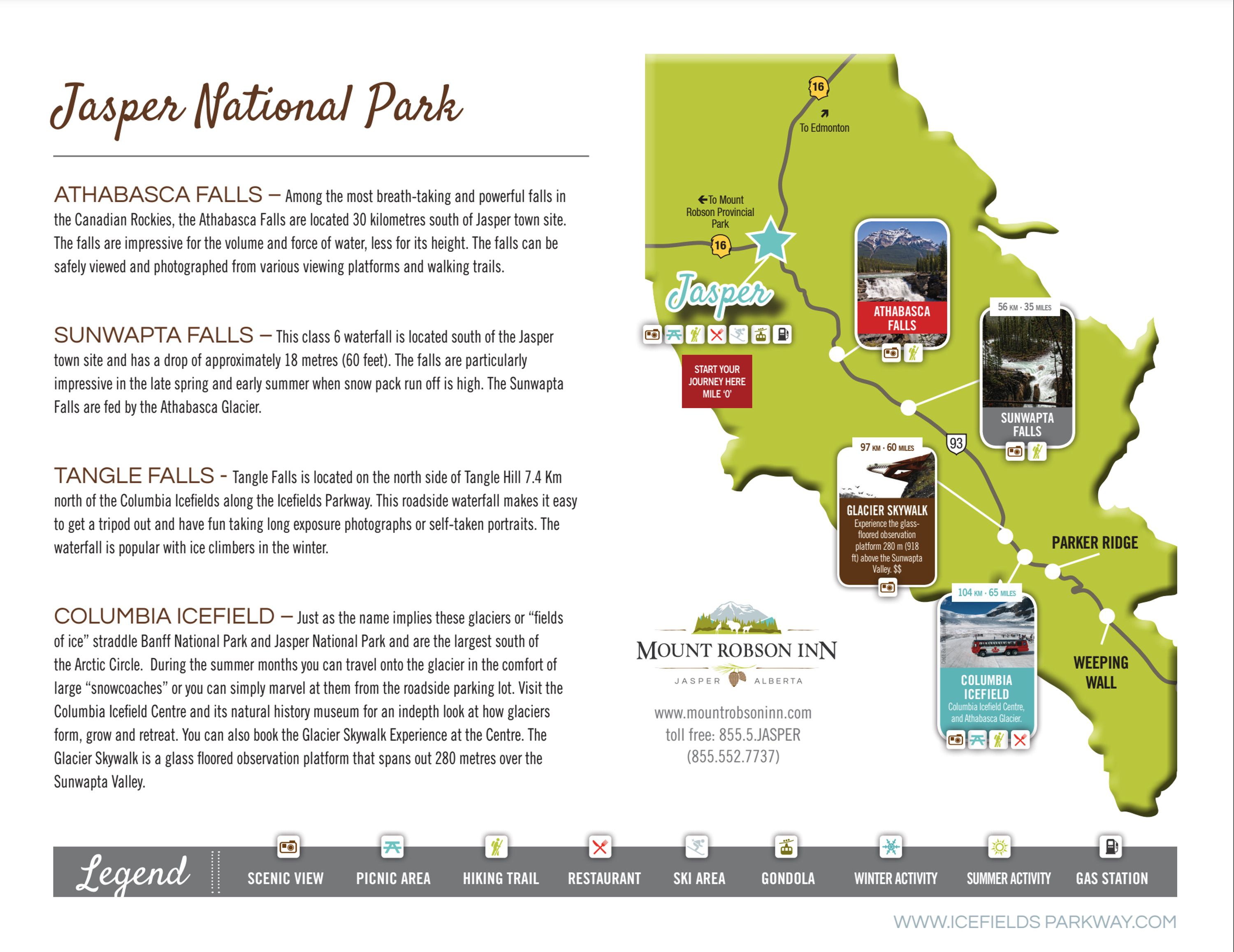
These top-rated hotel properties sit right at the parkway's access points in Lake Louise, Jasper and Valemount, so you can start your drive early, stop as often as you like, and never feel rushed to make it back before dark.
Get your Icefields Parkway Guide Map


